Sunday, March 13, 2011

Street Art revisited and a Weather Report from Piazza Beccaria

On Sunday, March 6, we described some interesting urban art that we had seen around Florence. Today a friend showed us an article from The Florentine, a bi-weekly newspaper in English for the English-speaking and English-reading community in Florence. The Florentine is a very good newspaper that we enjoy reading while we’re here and at least as much from time to time when we are at home.
The article in The Florentine describes an artist named Chet Abraham who is responsible for the altered traffic signs we described. He has some other projects, a workshop that we will visit soon, and a 400 Euro fine from the local authorities.
As we set these words down, we are thinking about you, the people who may be reading this. Some of you may not admire Chet’s work but some of you may enjoy his artistic sensibility. We know who you are ... or at least we think we know who you are.
Weather report   The first week of March was cool and damp and we were jet lagged so the combination was tolerable. The second week of March brought in weather from a place that a local person called “RUU see yah” (that is, Russia.) The nights were cold, into the 30s, and the days were cool, dry, and sometimes windy but the skies were blue, blue, blue. It was a pleasant change from the weather at home.
The photo summarizes the weather here; it shows a magnolia in a piazza near our apartment. Every year we’ve arrived and this magnolia has greeted us with the beautiful display that these trees put on in the spring.
We think that the weather here is about 6 or 7 weeks ahead of the weather at home. This gives us the opportunity to enjoy the coming of spring here and then go home and watch spring arrive again.

Friday, March 11, 2011

Big East Quarter Final from the House of Sizzle

Last evening we spent a few hours at a college-age watering hole called the House of Sizzle. We arrived at about 8pm, in time for the SU-St. Johns game which began at 8:25pm local time. We enjoyed a couple of Heinekens while watched the Big East quarter final game with a number of students, mostly SU fans but a few fans of other Big East teams, too. We joked that we were sent by their parents to keep an eye on things. For some reason that didn’t seem to amuse them.
We first met the owner of the House of Sizzle, Francesco, in 2003 when we were searching for a place to watch the NCAA Final Four games. He showed the championship weekend games that year on two old TVs, grainy and small, but at least we could see Hakim Warrick block that last, open three-point shot by Kansas that sealed the win and the national championship for SU.
Francesco has hailed us every year since. We’ve never dropped to try his hamburgers and french fries but we have said “Hello” at least once each trip. Now he has a number of flat screen TVs in a number of spots around his place and continues to attract students and a few adults who are interested in sports at home.
The students were friendly including a lone St. Johns fan who was, of course, disappointed in the result. Francesco, who has an Italian father and an English mother and who speaks perfectly accented Italian and interestingly accented English, was a gracious host.
What will we do Friday night? And Saturday night? The Friday game will be late, at 1am local time, and the Saturday game, if SU wins Friday will begin after 3am. We can’t do both so we will probably hope for an SU win Friday and, perhaps, take in the Saturday (Sunday morning) game.

Thursday, March 10, 2011

Lunch at Il Teatro del Sale

Happy birthday, David.


The Teatro del Sale is another interesting Florentine place to sit down for lunch or for dinner. The Teatro del Sale is one the four Cibreo spots a few blocks from our apartment and is operated by the well-known restauranteur, Fabio Picchi. The Cibreo restaurant is famous and expensive, over 100 Euro per diner. The Cibreo trattoria adjoins the restaurant and serves the same food from the same kitchen at a fraction of the price. The trattoria, however, does not take reservations, has communal seating, offers no table cloths, and is quite austere. The Cibreo café is across the street and serves coffee, teas, pastries, and light snacks.
Maria Cassi, the Italian comic actress, is married to Fabio Picchi. Together they purchased an old theater across the street from the three Cibreo places and established a club of sorts that serves lunch and dinner and offers evening shows. Maria Cassi performs frequently. The auditorium of the old theater has a flat floor, a stage, balconies, and is set with small tables and chairs. A kitchen is off to one side with a glass wall so diners can watch food being prepared.
Here are a few of the ways in which the Teatro del Sale is unusual. 
You must join the Circo-lo, a social circle, to enter. A one year membership is 5 Euro. Lunch is a flat 20 Euro, dinner is a flat 30 Euro and includes a show of some kind.
Cool and room temperature dishes are served at a table at the back of the small auditorium on small plates. Sample what you like, pass by the things that don’t interest you. Throughout the meal the dishes are replenished and new dishes appear. These dishes include salads, polentas of various types, small pieces of veal served in a tomato sauce, an interesting combination of cubed beets and potatoes served with thin sliced red onion and dressed with oil and wine vinegar. (Does it sound strange? It was really good. If we can figure out how to prepare it, we may inflict it on you after we get back.)
During the meal a cook in the kitchen will open a glass Dutch door from time to time and announce in a booming voice that a hot dish is being served at that moment. At the beginning of the meal the cook will offer hot schiacciata, thin crusty Florentine bread, brushed with oil, salted, with a  touch of rosemary. Later a pasta course will be offered. Finally a meat course will be announced, chicken, sausages, marinated pork which has been turning on a spit in the kitchen. With each announcement a line forms at the kitchen and diners take little plates back to their tables. 
The atmosphere is very festive. The little plates pile up and are taken away. This is the most fun of the meal.
The meal winds down and staff members offer coffee and dessert. When we were there last the dessert was, among other choices, small pieces of a soft, chewy intensely-chocolate cake. 
Diners may serve themselves with red or white wine and still or sparkling water. Coffee and dessert are included. There is no need to tip. 

Wednesday, March 9, 2011

Antica Tripperia Nerbone

Antica Tripperia Nerbone translates as “Nerbone’s Old Tripe Stand”  It is a well known Florentine landmark. Tripe stands are big in Florence. It is a local delicacy. And as much as we love all things Florentine, tripe is one delicacy that we have passed up for the last nine years and counting. Fortunately, “Nerbone” (ner-bon-eh) has evolved. Located within the large Mercato Centrale near San Lorenzo, Nerbone not only makes all the guide books, but is also featured in our culinary bible, L’Osterie d’Italia (a guide to local and regional dining in Italy). It is a place to go for a traditional Tuscan meal (i.e. antipasti, pasta or zuppa, meat or fish, side dishes of vegetables or salad, bread, wine) without any formalities or traditional ammenities whatsoever: no tablecloths, no wine list, no placemats, no waiters. It is located on an inside corner of the Mercato Centrale with the serving kitchen on one side of the aisle and a bank of tables on the other side of the aisle. You stand in line to make your selection, then take your tray to any seat you can find at a table across the way. Oddly, it all works out. By the time you receive your meal, someone else has finished theirs, so there is a place for you to sit.  Your table partners can range from local workmen on their lunchbreak to wealthy Japanese tourists. It’s the luck of the draw.
There is always a line. I think the tripe had put us off in the past, but this year we vowed to try it. We were also encouraged by a nice American woman who said she ate there every day. While they do still offer tripe, the rest of the menu is traditional Tuscan fare and it changes every day. You select whatever you want. The portions are ample. We both started with a beautiful risotto of leeks and pancetta. We split a large dish of lightly marinated artichokes and a dish of turkey slices in a delicate mushroom sauce. Add a half liter of wine and we were in Heaven. This, in spite of the fact that the mercato is not heated and it was a co-o-o-old day. We ate in our coats and hats. It only added to the unique culinary ambience... Not fancy, this place. But the food was really good. Oh, and did I mention that the whole thing for the two of us came to just under 25 euro? We’ll put Nerbone into our rotation of great cheap eats in Florence.

Tuesday, March 8, 2011

Protests on March 8, La Festa delle Donne

The banner reads "Journeys for
women, journeys for peace".

March 8 in Italy is the Festa delle Donne, the Festival of the Women and it falls on the International Women’s Day. Italian men mark the Festa delle Donne in a way that seems to resemble, slightly at least, Valentine’s Day in our country. Men are expected to pick up sprays of little yellow spring flowers which are called mimosa in Italy. The flowers are small and delicate and last no more than a day; Italian women note, ruefully, that the celebration of women also lasts no more than a day.
Marching through Piazza San
Ambrogio, near our apartment.
The banner reads "Free all".
This year the celebration was much more edgy. The Italian Prime Minister, Silvio Berlusconi, has not ingratiated himself to Italians in general and to Italian women in particular with his “bad boy” behavior. “Bad boy”, however, is too mild a way to describe his problems. Berlusconi has been accused of keeping intimate company with  young ladies who were under the age of legal consent in Italy. There were already financial and legal scandals in the public mind and the sex scandals have raised the temperature still higher.

Many women wore this sign.
Italian women, including Tuscan women, are not amused by the Prime Minister’s behavior. This year the Festa dell Donne in Italy was reason for demonstrations that gathered people from many points of view but the coarse behavior of the country’s leader dominated the concerns expressed by the women and men who marched to protest the behavior of their Prime Minister. 
The sign reads "Not just meat".


Here are some pictures from today’s demonstration in Florence.


Monday, March 7, 2011

La Fiorentina vs. Catania/ A Culture Walk

Due tifosi fiorentini

Florence played Catania this Sunday afternoon before 21,000 local fans (in Italian, fans are tifosi), two of them recent arrivals from the land of Otto the Orange. Since we were in the land of La Viola, the color of the Florentine soccer team, we put the orange aside in favor of, as they call it here, viola.
Florence won the match 3 to nil. Catania passed well but Florence’s two offensive stars, Adrian Mutu and Alberto Gilardino, were too much for the Catania defenders. Mutu scored twice in the first half on passes from Gilardino. Gilardino scored once in the second half on a pass from Mutu.
A family of tifosi viola
We spent an afternoon in a concrete stadium, singing and cheering with the Florentines. There was a good turn out of young and old and the fans were sometimes grumpy but never intoxicated since no alcohol is sold in the stadium. Perhaps a weak opponent against a disappointing local team had kept some of the more outspoken fans at home. Except for some occasional colorful language, it was a family-friendly atmosphere.
Florence has not had a good year; Florence is in eleventh place in the twenty team A league. Catania, however, is worse, fourteenth in the same A league. Interestingly, here the bottom four teams in the A league get dropped (or as they say, relegated) to the B league and, correspondingly, the top of the B league teams get promoted to the A league. Catania is staring that possibility, that terrible shame, straight in the face. Florence is not facing that fate but the Florentines are accustomed to a better performance than they’ve seen so far this year.
We attended the game with Sondra, a retired political science professor, who has many connections to our family, too many to begin to go through here. She enjoys the games and  likes to enlarge her considerable knowledge of colloquial vocabulary and usage.

A side note:  We hate to leave the impression that we’re in an artistic jewel of a city and that we’re only yelling at opposing soccer teams. Yes, we are yelling at opposing soccer teams but we’ve also had some pleasant uplifting experiences. 


Today we visited Orsanmichele Church in the center of town. It was a combination church on the ground floor and granary on the upper floors, an expression of Florentine pragmatism. The upper floors are now a museum containing the sculptures done by Florentine masters and placed in niches on the outside on the ground level. The outside niches now contain copies and the originals are out of the elements on the second floor.
Opposite end of the stadium,
reserved for the most serious tifosi
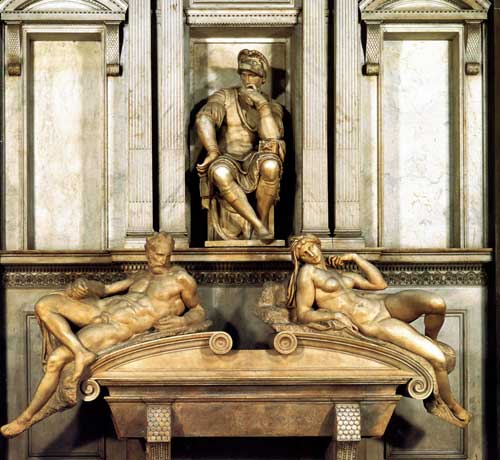
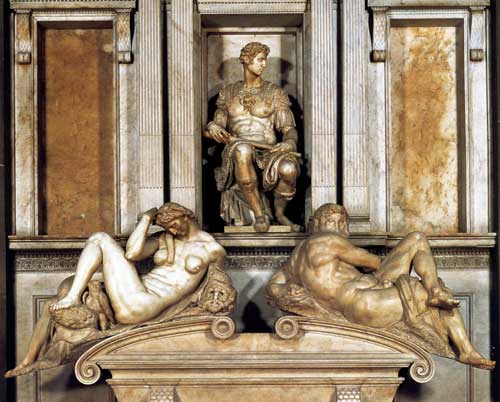
On Saturday we visited Medici Tombs. Michelangelo designed the space, designed the details, and sculpted seven statues. Two of the Medici, Lorenzo and Giuliano, were depicted as the Thoughtful Life and the Active Life respectively. In front of representations of the passage of time. Below Lorenzo and on his tomb are massive reclining figures of Dusk (left) and Dawn (right). Below Giuliano and on his tomb are massive figures of Night (left) and Day (right). Lorenzo and Giuliano face each other across the room and are turned toward a Madonna and Child on the wall between them. 


Seven pieces by Michelangelo in a somber space designed by the artist. It’s a lot to think about.
Mutu passes

But enough of culture. Sunday's soccer game drew a restless crowd. Until the first score there was quite a lot of coaching from the seats. Then people chanted MU TU for the Romanian striker who made the first score. A few minutes later the cheer was repeated when Mutu scored again. We were sitting in one of the ends of the stadium and this action was at the other end, in front of the most rabid Florentine Viola fans who were waving flags, singing, and cheering.
Gilardino scores!
The teams reversed direction for the second half and Mutu repaid Gilardino for his assists in the first half. In a play that developed in what seemed like an instant, Mutu drove to the goal, passed to Gilardino, and Gilardino scored. Somehow I caught the action that took place in front of us.
Is this really a good idea?
As the game closed some of the male spectators at the bottom of our section celebrated  the victory Green Bay-style by waving banners and their shirts. It was a sunny but cool day, a little too cool for a sane person to be testing the air temperature au natural.

At the end of the game Florence moved up to tenth place and Catania fell to sixteenth place. It must have been a quiet ride back to Catania.


Sunday, March 6, 2011

Department of Wry Public Art

Florence is a city full of art, a city of art. There are tabernacles on the sides of many buildings. There are statues in courtyards and, of course, there are courtyards everywhere. There are impressive palaces, churches, and civic buildings adorned inside and out with paintings and sculptures. In fact, even our apartment is in a building with a lovely statue guarding the mailboxes in the lobby. (By the way, please see the Thursday, March 3 post for an important announcement.)
All this art is not lost on the current generation of Florentines. Which brings us to the ...
Department  of Wry Public Art
Florence uses international traffic signage, signs that give you useful advice about traffic and street layouts without words, only simple symbols. We’ve found two of these signs to have been slightly modified by local artists in amusing ways.
The first sign was near the soccer stadium, an area we visited earlier this week when we picked up tickets for Sunday’s game, Florence versus Catania. The sign is the international sign for Do Not Enter which was posted, in this case, on a one-way street. A slight modification has been made to the sign.
The second sign warns the motorist that there is a T intersection ahead. Perhaps the urban artist was inspired by the fact that the intersections ahead happens to be on the side of one of Florence’s main cathedrals, Santa Croce.